
When dashboards stop answering your questions
You're managing a growing portfolio. A few multifamily buildings, maybe some mixed-use, possibly across different cities. Every week, you pull numbers from property managers, export spreadsheets, update dashboards, and try to understand what's actually happening. Occupancy is down in one asset, expenses are creeping up in another, and you're not entirely sure why. The common assumption is that better spreadsheets or more dashboards will fix this. But the issue isn't the tools. It's the lack of clarity in how you interact with your data. This article will show you what actually changes with AI-powered analytics, and how to use that shift to make faster, better decisions across your portfolio.
From asking questions to exploring performance
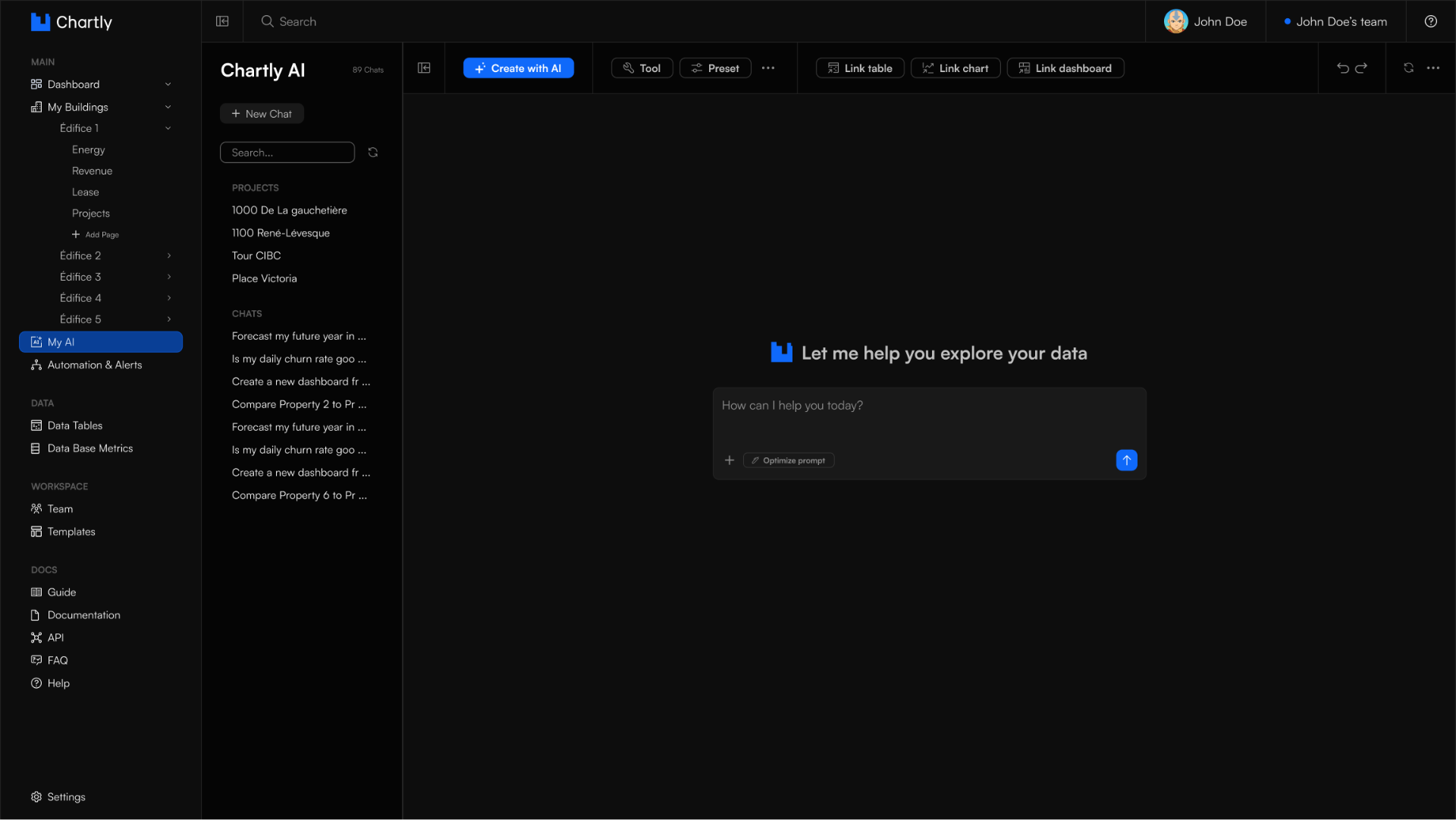
Traditional business intelligence works well when you already know what you're looking for. You build dashboards to track occupancy, rent per unit, NOI, and a handful of KPIs. You click through filters, compare time periods, and try to extract meaning. But this model assumes something important: that you already know the right questions. In real estate, that's rarely the case. Performance issues often hide in the gaps between metrics. AI-powered analytics changes this by turning data into something you can interact with directly. Instead of navigating dashboards, you explore your portfolio through conversation. You can ask why occupancy dropped in a specific building, compare similar properties, or identify patterns across units without pre-building every view. It's not just faster reporting. It's a different way of thinking.
What AI analytics actually looks like in real estate
There's a tendency to think of AI analytics as a layer on top of existing dashboards. In practice, it's closer to a system that connects your data, structures it, and makes it usable in real time. In a real estate context, that means your portfolio, properties, and units are all part of a unified model. Revenue, expenses, occupancy, lease terms, and operational data are continuously updated and accessible. Instead of opening multiple reports, you can ask simple questions like "Which properties have declining margins despite stable occupancy?" or "What's driving expense growth in this region?" The system doesn't just return numbers. It helps you navigate relationships between them. This is where it goes beyond traditional BI. It's not about visualizing data you already understand. It's about uncovering what you don't.
Why this shift impacts ROI and decision-making
Real estate decisions are time-sensitive. Pricing units, planning renovations, acquiring assets, or cutting costs all depend on having a clear view of performance. When your analytics are slow or fragmented, decisions lag behind reality. You might miss early signs of declining demand, overlook inefficient cost structures, or misprice units based on outdated comparisons. Over time, these small gaps compound into real financial impact. AI-driven analytics reduces that delay. It shortens the distance between data and decision. Instead of waiting for monthly reports, you can react as trends emerge. This doesn't just improve efficiency. It directly affects returns by helping you act earlier and with more confidence.
Turning data into a usable system
The real advantage doesn't come from the technology itself, but from how you structure your data around it. It starts with understanding what actually matters. Not every metric deserves attention. Revenue, occupancy, operating costs, and a few key drivers behind them are usually enough to build a clear picture. Once that's defined, the next step is organizing this information across your portfolio in a consistent way. Each property should follow the same structure, each unit should feed into that structure, and everything should roll up cleanly to the portfolio level. With that foundation, AI becomes useful because it has context. You can move from high-level performance down to specific units without friction, and from there to decisions like adjusting rent, planning capital expenditures, or evaluating acquisitions.
Focusing on what drives decisions, not just what's measurable
A common trap is tracking everything simply because you can. More data feels like more control, but it often leads to noise. The goal is not to build the most detailed system. It's to build one that highlights what actually moves the business. When your data is structured correctly, you can focus on a small number of signals that matter and ignore the rest. This is where AI helps by guiding attention rather than just displaying information. It surfaces anomalies, highlights trends, and connects data points that would otherwise stay isolated. Over time, this creates a feedback loop where decisions improve because they're based on clearer signals.
Applying this approach as an individual or a team
If you're managing a smaller portfolio or working independently, the shift can be simple. Start by consolidating your data into one place, define a few key metrics, and use AI tools to explore rather than just report. The goal is not to build a perfect system, but to reduce friction between questions and answers. For larger teams, the impact comes from consistency. When everyone works from the same structured data and can access insights easily, alignment improves. Asset managers, property managers, and executives can all operate from the same reality instead of interpreting different reports. This reduces miscommunication and speeds up execution across the organization.
Where most real estate teams go wrong
The biggest mistake is overcomplicating the system before it proves its value. Teams often invest in complex dashboards, track dozens of metrics, and still struggle to make decisions. Another common issue is treating analytics as a reporting function rather than a decision tool. Data gets collected, visualized, and reviewed, but not acted on. AI doesn't fix these problems automatically. If anything, it makes them more visible. Without a clear structure and focus, even the best tools will produce more confusion instead of clarity. The goal is to simplify first, then enhance.
Clarity is the real advantage
The shift from traditional BI to AI analytics is not about replacing dashboards with something more advanced. It's about changing how you interact with your data. In real estate, where decisions compound over time, clarity matters more than complexity. The teams that win are not the ones with the most data, but the ones who can understand and act on it quickly. Start simple, focus on what matters, and let your system evolve. That's where the real return comes from.